

Questions in category: 概率论 (Probability)
概率统计 >> 概率论 [97]
<[1] [2] [3] [4] [5] [6] [7] [8] [9] [10] >

71. [Notes] Some notes of Probability and Statistics

Posted by haifeng on 2020-03-03 08:10:52 last update 2020-03-16 16:59:35 | Answers (0) | 收藏


Axioms of Probabilies:

Suppose $\Omega$ is the sample space, $A$ and $B$ are events. The probabilities should obey the following rules:

(1) $P(A)\geqslant 0$,

(2) $P(\Omega)=1$;

(3) If $A,B\subset\Omega$ and $A\cap B=\emptyset$, then $P(A\cup B)=P(A)+P(B)$.


Thm. $P(A)\leqslant 1$, $\forall\ A\subset\Omega$.

Proof. By axioms, $1=P(\Omega)=P(A\cup A^c)=P(A)+P(A^c)$, then we have

\[P(A)=1-P(A^c)\leqslant 1\]


Cor. If $A,B,C\subset\Omega$, and $A,B,C$ are disjoint sets. Then

\[
P(A\cup B\cup C)=P(A)+P(B)+P(C)
\]

Proof. Since $A,B,C$ are disjoint sets, $A$ and $B\cup C$ are disjoint. Thus

\[
P(A\cup B\cup C)=P(A\cup (B\cup C))=P(A)+P(B\cup C),
\]

and by Axiom(3), $P(B\cup C)=P(B)+P(C)$, substitute it in the above, we get

\[
P(A\cup B\cup C)=P(A)+P(B)+P(C).
\]


It is easy to infer the following corollary.

Cor. If $A_1,A_2,\ldots,A_n$ are disjoint sets in $\Omega$, then

\[
P(A_1\cup A_2\cdots A_n)=P(A_1)+P(A_2)+\cdots+P(A_n).
\]

Proof. By mathematical induction.


Cor. If $s_1,\ldots,s_n$ are $n$ distinct points(or outcomes) in $\Omega$ then

\[
P(\{s_1,\ldots,s_n\})=P(\{s_1\})+\cdots+P(\{s_n\})=P(s_1)+\cdots+P(s_n).
\]

Here, we use $P(s_i)$ to denote the probability $P(\{s_i\})$.


Suppose the sample space have $N$ points, and event $A$ has $n$ points. Here $\Omega$ is a finite set, i.e., $N < \infty$.  If all outcomes are equally likely, then 

\[
P(A)=\frac{\text{number of elements of}\ A}{\text{total number of sample points}}=\frac{\# A}{\#\Omega}
\]


Example. If $A,B$ are two subsets of $\Omega$. Let $C=A-B=A\cap B^c$, $D=B-A=B\cap A^c$, $E=A\cap B$.

Then we have $P(C\cup D)=P(A)+P(B)-2P(E)$.

Solution. 

Note that $C$ and $D$ are disjoint, hence we have

\[
P(C\cup D)=P(C)+P(D).\tag{1}
\]

On the other hand, $A=C\cup E$, $B=D\cup E$, and $C\cap E=\emptyset$, $D\cap E=\emptyset$. Thus

\[
\begin{aligned}
P(A)&=P(C)+P(E),\\
P(B)&=P(D)+P(E).
\end{aligned}
\]

It infers that $P(A)+P(B)=P(C)+P(D)+2P(E)$. By using (1), we have

\[
P(C\cup D)=P(A)+P(B)-2P(E).
\]


Prop. Suppose $A,B\subset\Omega$, we have

\[
P(A\cup B)=P(A)+P(B)-P(A\cap B).
\]

Proof. 

\[
P(A\cup B)=P(A\cup(B-A))=P(A\cup(B\cap A^c))=P(A)+P(B\cap A^c).
\]

Note that $P(B)=P(B\cap A^c)+P(B\cap A)$, we substitute it in the above formula, and get

\[
P(A\cup B)=P(A)+P(B)-P(A\cap B).
\]


Prop. Suppose $A,B,C\subset\Omega$, we have

\[
P(A\cup B\cup C)=P(A)+P(B)+P(C)-P(A\cap B)-P(A\cap C)-P(B\cap C)+P(A\cap B\cap C).
\]


Exercise. Using the axioms to show that if one event $A$ is contained in another event $B$ (i.e. $A$ is a subset of $B$), then $P(A)\leqslant P(B)$.

For general $A$ and $B$, what does this imply about the relationship among $P(A\cap B)$, $P(A)$ and $P(A\cup B)$ ?

Solution. Since $A\subset B$, $B=A\cup(B\cap A^c)$, here $A$ and $B\cap A^c$ are disjoint. Thus by axioms,

\[
P(B)=P(A)+P(B\cap A^c)\geqslant P(A).
\]

For general $A$ and $B$, we have $A\cap B\subset A\subset A\cup B$, thus we have

\[
P(A\cap B)\leqslant P(A)\leqslant P(A\cup B).
\]
72. subsystem 问题

Posted by haifeng on 2020-02-26 16:33:58 last update 2020-02-26 16:40:05 | Answers (1) | 收藏


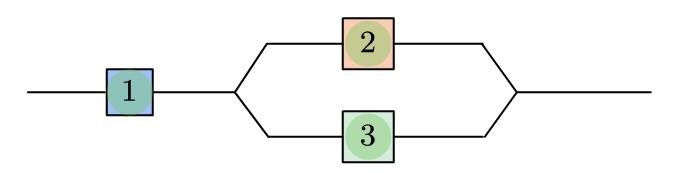
Three components are connected to form a system as shown in the accompanying diagram. Because the components in the 2-3 subsystem are connected in parallel, that subsystem will function if at least one of the two individual components functions. For the entire system to function, component 1 must function and so must the 2-3 subsystem.

The experiment consists of determining the condition of each component [$S$ (success) for a functioning component and $F$ (failure) for a nonfunctioning component].

A. What outcomes are contained in the event $A$ that exactly two out of the three components function?
B. What outcomes are contained in the event $B$ that at least two of the components function?
C. What outcomes are contained in the event $C$ that the system functions?
D. List outcomes in $C^{c}$, $A\cup C$, $A\cap C$, $B\cup C$, and $B\cap C$.


Reference:

Jay L. Devore, Probability and Statistics, For Engineering and The Sciences (Fifth Edtion)

73. 学校篮球队比赛问题

Posted by haifeng on 2020-02-26 16:08:18 last update 2020-02-26 16:40:23 | Answers (1) | 收藏


Four universities -- 1,2,3 and 4 -- are participating in a holiday basketball tournament. In the first round, 1 will play 2 and 3 will play 4. Then the two winners will play for the championship, and the two losers will also play. One possible outcome can be denoted by 1324 (1 beats 2 and 3 beats 4 in first round games, and then 1 beats 3 and 2 beats 4).


A. List all outcomes in $\mathcal{S}$.
B. Let $A$ denote the event that 1 wins the tournament. List outcomes in $A$.
C. Let $B$ denote the event that 2 gets into the championship game. List outcomes in $B$.
D. What are the outcomes in $A\cup B$ and in $A\cap B$? What are the outcomes in $A^{c}$?


Reference:

Jay L. Devore, Probability and Statistics, For Engineering and The Sciences (Fifth Edtion)

74. [Def]离散概率空间(Discrete Probability Space)

Posted by haifeng on 2020-02-25 17:17:35 last update 2020-02-25 17:18:37 | Answers (0) | 收藏


Definition. Let $\Omega$ be a finite or countable set. Let $p:\Omega\rightarrow[0,1]$ be a function such that \[\sum_{\omega\in\Omega}p_{\omega}=1.\]

Then $(\Omega,p)$ is called a discrete probability space. $\Omega$ is called the sample space and $p_{\omega}$ are called elementary probabilities.


定义: 设 $\Omega$ 是一个有限集或可数集. 设 $p:\Omega\rightarrow[0,1]$ 是 $\Omega$ 上的一个函数, 满足 \[\sum_{\omega\in\Omega}p_{\omega}=1.\]

则 $(\Omega,p)$ 被称为一个离散概率空间. $\Omega$ 被称为样本空间, $p_{\omega}$ 称作为基本概率.


References:

Manjunath Krishnapur, Probability and Statistics

75. 黑白棋概率问题

Posted by haifeng on 2020-02-21 08:34:00 last update 2020-02-21 08:34:00 | Answers (1) | 收藏


在 $20\times 5$ 的格子上, 有90个白棋, 10个黑棋. 任意放在每个格子中. 求

Q1. 存在一行有3个以上黑棋的概率.

Q2. 存在两行有3个以上黑棋的概率.

Q3. 存在三行有3个以上黑棋的概率.


Remark:

题目来源: David Chen(陈)

76. 证明: 正态分布的峰度是3.

Posted by haifeng on 2018-08-11 21:58:38 last update 2018-08-11 22:00:40 | Answers (0) | 收藏


证明: 正态分布的峰度是3.


峰度的定义

\[
g_2=\frac{1}{s^4}\sum_{i=1}^{n}(X_i-\bar{X})^4,
\]

其中 $s$ 指标准差, 定义为

\[
s=\biggl[\frac{1}{n-1}\sum_{i=1}^{n}(X_i-\bar{X})^2\bigg]^{\frac{1}{2}}.
\]

77. $\chi^2$-分布的可加性

Posted by haifeng on 2018-06-02 10:14:24 last update 2018-06-02 10:14:24 | Answers (1) | 收藏


性质. ($\chi^2$-分布的可加性)

若 $Y_1,Y_2,\ldots,Y_k$ 相互独立且都服从 $\chi^2$-分布, 自由度分别为 $n_1,n_2,\ldots,n_k$. 即

\[
Y_i\sim\chi^2(n_i),\quad i=1,2,\ldots,k,
\]

\[
\sum_{i=1}^{k}Y_i\sim\chi^2(n),\quad\text{where}\ n=\sum_{i=1}^{k}n_i.
\]

78. 两个正态总体的统计量的分布

Posted by haifeng on 2018-06-02 07:09:51 last update 2018-08-12 12:52:28 | Answers (3) | 收藏


设 $X$ 和 $Y$ 是分布服从 $N(\mu_1,\sigma_1^2)$ 和 $N(\mu_2,\sigma_2^2)$ 的两个总体. 分别从它们中抽取容量为 $n_1$ 和 $n_2$ 的样本 $\{X_i\}_{i=1}^{n_1}$, $\{Y_j\}_{j=1}^{n_2}$. 假设所有的抽样都是相互独立的, 由此得到的样本 $X_i$ 和 $Y_j$ 都是相互独立的随机变量.

设样本 $\{X_i\}_{i=1}^{n_1}$, $\{Y_j\}_{j=1}^{n_2}$ 的均值分别为 $\bar{X}$ 和 $\bar{Y}$, 样本方差分别为 $s_1^2$ 和 $s_2^2$, 则有


(1)

\[
U:=\frac{(\bar{X}-\bar{Y})-(\mu_1-\mu_2)}{\sqrt{\frac{\sigma_1^2}{n_1}+\frac{\sigma_2^2}{n_2}}}\ \sim\ N(0,1).
\]

特别地, 若 $\sigma_1=\sigma_2=\sigma$ 时, 有

\[
U:=\frac{(\bar{X}-\bar{Y})-(\mu_1-\mu_2)}{\sigma\sqrt{\frac{1}{n_1}+\frac{1}{n_2}}}\ \sim\ N(0,1).
\]


(2)

\[
F:=\frac{\frac{s_1^2}{\sigma_1^2}}{\frac{s_2^2}{\sigma_2^2}}\ \sim\ F(n_1-1,n_2-1).
\]


(3)

若 $\sigma_1=\sigma_2$, 则

\[
T:=\frac{(\bar{X}-\bar{Y})-(\mu_1-\mu_2)}{s\sqrt{\frac{1}{n_1}+\frac{1}{n_2}}}\ \sim\ t(n_1+n_2-2),
\]

其中

\[
s=\sqrt{\frac{(n_1-1)s_1^2+(n_2-1)s_2^2}{n_1+n_2-2}}.
\]


References:

赵静、但琦 等编 《数学建模与数学实验》(第四版),  高等教育出版社.  P. 186.

79. $t$ 分布 $t(n)$

Posted by haifeng on 2018-05-29 13:22:12 last update 2018-05-29 13:22:12 | Answers (0) | 收藏


$t$ 分布 $t(n)$


若 $X\sim N(0,1)$, $Y\sim\chi^2(n)$, 且互相独立, 则随机变量 $T:=\frac{X}{\sqrt{\frac{Y}{n}}}$ 服从自由度为 $n$ 的 $t$-分布, 记为 $T\sim t(n)$.


80. 单个正态总体统计量的分布

Posted by haifeng on 2018-05-29 13:01:32 last update 2018-06-01 15:07:10 | Answers (3) | 收藏


设总体 $X\sim N(\mu,\sigma^2)$, $X_1,X_2,\ldots,X_n$ 是一容量为 $n$ 的样本, 其均值记为 $\bar{X}$, 标准差记为 $s$, 则有

(1)

\[
\bar{X}\sim N(\mu,\frac{\sigma^2}{n}),
\]

或等价的,

\[
\frac{\bar{X}-\mu}{\frac{\sigma}{\sqrt{n}}}\sim N(0,1).
\]


(2)

\[
\frac{\sum_{i=1}^{n}(X_i-\mu)^2}{\sigma^2}\sim\chi^2(n-1),
\]

\[
\frac{(n-1)s^2}{\sigma^2}\sim\chi^2(n-1).
\]


(3)

\[
\frac{\bar{X}-\mu}{\frac{s}{\sqrt{n}}}\sim t(n-1).
\]


References:

赵静、但琦 等编 《数学建模与数学实验》 高等教育出版社  P. 186.

<[1] [2] [3] [4] [5] [6] [7] [8] [9] [10] >